Georgetown Neighborhood Guide Worth Exploring
Georgetown is the tourist quarter with no Metro stop and an old-money zip code, and it is still worth a full day on foot if you skip the chain storefronts and walk toward the water.
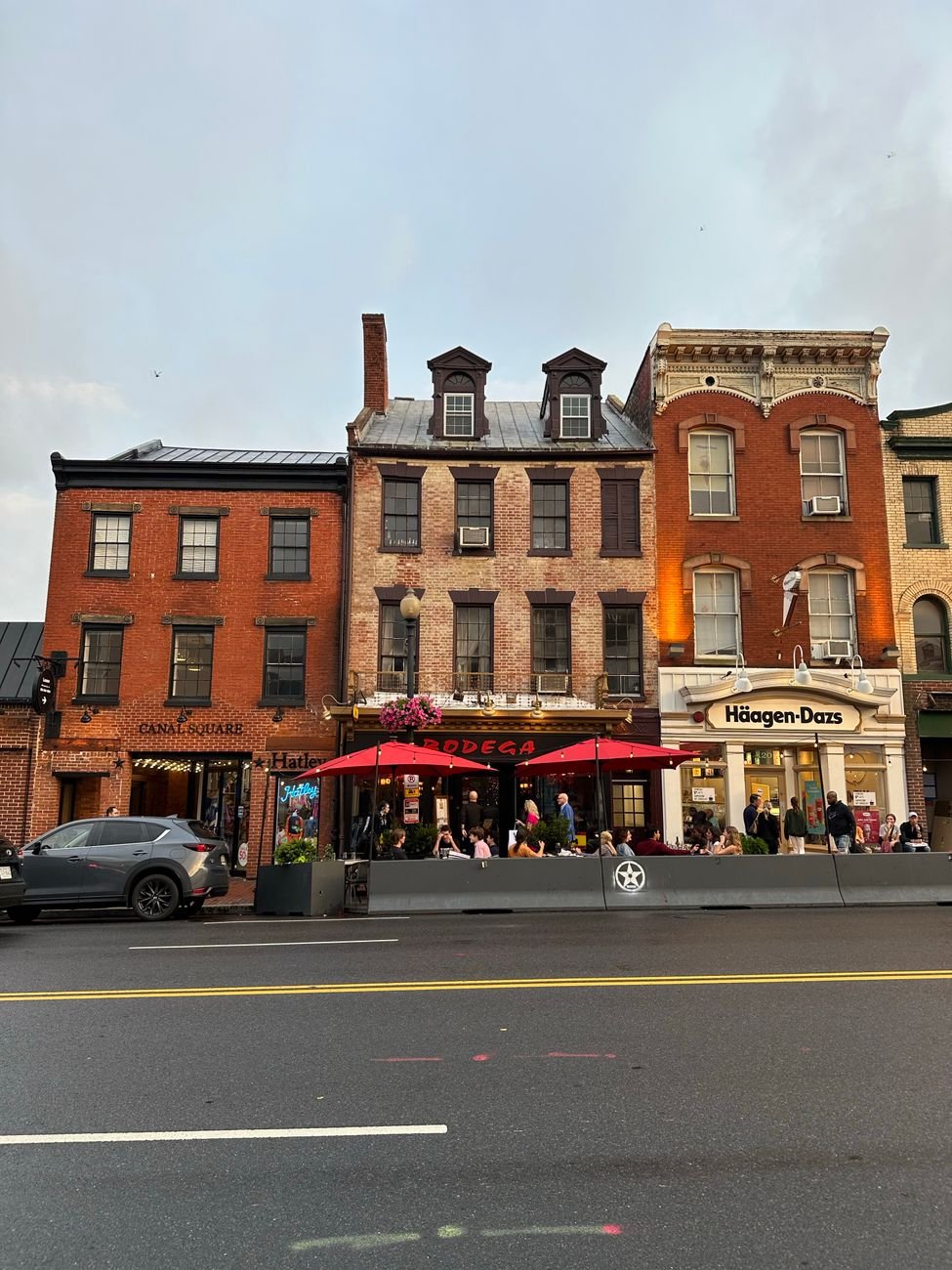
Walk down from Wisconsin Avenue toward the water and the brick sidewalk starts to buckle over old tree roots, then the street itself turns to cobblestone, uneven enough that you slow your steps without deciding to. The C&O Canal runs a flat green line just below the shops, towpath and all, and past it the Potomac opens up beyond warehouses that once moved flour and coal instead of brunch crowds. Any Georgetown neighborhood guide worth reading has to start down here, at the bottom of the hill, because the version most visitors get sold — the storefronts on M Street, the university spires above the rooftops — only makes sense once you feel how sharply this ground drops toward the river.
Here is the honest part first. Georgetown is the oldest money in the city and the most tourist-heavy blocks in Ward 2, and locals from other parts of DC roll their eyes at it for good reason. It skews white and wealthy in a city that is majority Black and working, and it can feel, on a Saturday afternoon in summer, like a mall that happens to have federal-era rowhouses attached. All of that is true. It is also true that if you know how to walk it, past the same six retail chains you can find in any city, Georgetown still delivers a genuinely good day out.
A Georgetown Neighborhood Guide Has to Start With How You Get There
The first thing to know, and the thing every out-of-towner forgets to plan for, is that Georgetown has no Metro stop. It never got one, and there is a long, petty history behind that gap involving neighbors who fought hard to keep the trains out decades ago. That means your options are a bus, the DC Circulator, a bike share dock, a cab, or your own two feet from Rosslyn or Foggy Bottom. Walking in from Foggy Bottom along Pennsylvania Avenue takes maybe twenty minutes and gives you a decent preview of the architecture before you hit the commercial strip. Parking on the residential side streets is tight and often permit-only, so plan around that rather than fighting it once you arrive.
Where the Water Does the Talking
Skip the shops for your first hour and head straight for the water. The Georgetown waterfront gives you open sightlines down the Potomac, boathouses, and a paved promenade that fills with runners and rowers early in the day. One block inland, the C&O Canal towpath runs shaded and mostly flat, a good stretch for a slow walk or a rented bike, and it is free, which is more than you can say for most of what surrounds it. The canal itself was a working shipping route in the 1800s, moving coal and grain down from Maryland long before anyone thought of this stretch as a place to spend a leisure afternoon. Stand on one of the small footbridges and you can see both eras at once: the old stone locks and the new glass condos stacked up behind them.
M Street, Wisconsin Avenue, and What's Actually Behind Them
The commercial crossroads of M Street and Wisconsin Avenue is where most visits start and, unfortunately, where a lot of them end. Push past the storefront strip and turn down any of the side streets running north from M Street and the character shows up fast: Federal rowhouses from the early republic, narrow lots, brick facades painted in the deep reds and blues that homeowners here have kept for generations. The steep block of stairs off Prospect Street, made famous by a horror movie, draws a steady stream of visitors taking photos, and it is worth the climb even if you have never seen the film, if only for the view back down toward the water. Further up the hill, Georgetown University's campus adds its own gravity, a small self-contained world of stone buildings and students cutting across the quad, separate from the shopping strip below.
Where to actually spend your time
- Walk the C&O Canal towpath at least a few blocks in either direction before you touch a store
- Turn off M Street onto the residential blocks to see the rowhouses that give the neighborhood its architectural reputation
- Budget real time at the waterfront park rather than treating it as a five-minute photo stop
- Climb the steps off Prospect Street for the view, not just the movie trivia
- Plan your transit before you go, since there is no train to fall back on
Finding Character Beyond the Chain Storefronts
The retail strip on M Street reads like an airport terminal in places, the same national chains you would find in any American downtown. The character is still there, it is just a block or two off the main drag, in the smaller shops on the side streets and in the older bars that have been serving the neighborhood since long before the boutiques moved in. Georgetown does not carry the food identity that defines a lot of the rest of the city, the half-smoke stands and mumbo sauce joints and Ethiopian restaurants that cluster in other corners of DC, and it would be dishonest to pretend otherwise. What it offers instead is architecture, water, and a walkable historic core, which is a different kind of value and worth being clear-eyed about before you show up expecting something it is not.
It's Ward 2, and It Isn't the Whole City
Georgetown sits in Ward 2, one of eight wards that make up a city of roughly 700,000 people, and it represents a narrow, moneyed slice of what DC actually is. The neighborhoods east of the Anacostia River, the rowhouse blocks of Wards 7 and 8, hold most of the city's Black cultural history and daily life, and they get a fraction of the visitor attention Georgetown pulls in on any given weekend. That imbalance is worth naming plainly rather than pretending a walk down M Street tells you much about the city as a whole. Georgetown is one neighborhood among dozens, old, wealthy, and picturesque in a specific colonial-era way, and it makes more sense once you see it as a single chapter rather than the whole book. For a fuller sense of how the rest of the city lives, the neighborhoods beyond the tourist core tell a different, more textured story.
The takeaway is simple enough. Georgetown earns its reputation as the postcard neighborhood, but the postcard version is only the surface. Go for the canal and the water, climb the side streets for the architecture, accept upfront that you will not find a train station or much of the city's food culture here, and treat it as one honest, specific piece of a much bigger city rather than a stand-in for all of it.